Chelsea_Sun ・ Mar. 18, 2026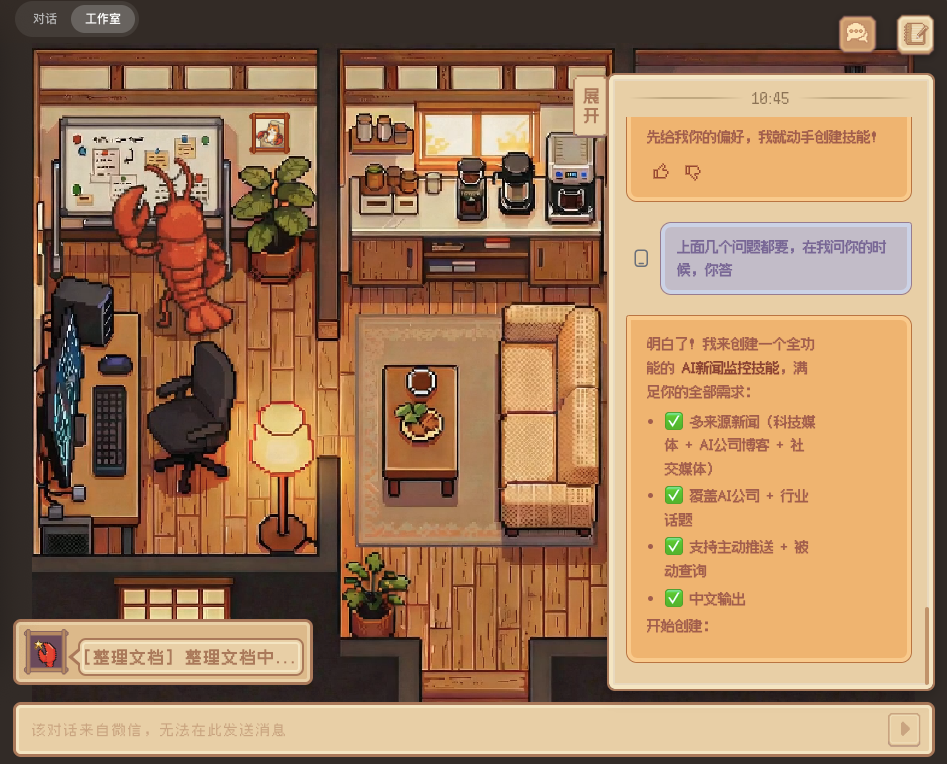
NextFin News -- Capital markets’ expectations for AI agents keep climbing. As of the close on Tuesday, March 17, Hong Kong stocks tied to the OpenClaw theme surged, with Xunce Technology (03317.HK)—dubbed the “first token stock” in Hong Kong—soaring more than 36%. On March 18, the Tencent concept stocks continued to rally intraday: Century Hengtong hit a 20% limit-up, and Orient Securities Information also touched a 20% limit-up.
Behind the frenzy of capital is a simple reality: tech giants are accelerating their efforts to wrench agents out of the hardcore, code-heavy geek circle and forcefully push them onto the desktops of everyday office workers.
On Wednesday, QClaw under Tencent announced a major version update (V0.1.9). It not only fully upgraded its WeChat entry point into a “Mini Program,” but also launched an “Inspiration Plaza” with preset commonly used tasks, and significantly expanded the scale of its internal beta rollout.
Jumping on internal beta access at the first opportunity, NextFin conducted in-depth hands-on testing.
Through QClaw, a tool built on the “lobster,” the nickname of OpenClaw in China, that’s been heavily revamped by a big tech company, we found that the giants’ move to “farm crayfish” was never simply about making a handy piece of software. Instead, it’s an extremely shrewd—and brutal—ecosystem calculation centered on traffic entry points, compute costs, and enterprise monetization.
A Super App’s Fight to Defend the Entry Point
In this round of testing, the most immediately visible change in QClaw was the upgrade to its cross-device control capabilities. After deployment on the PC, a standalone QClaw Mini Program appears in the user’s WeChat. The new version even supports receiving and uploading PC files directly within the WeChat Mini Program.
When we sent the instruction “Help me clean up the images on my computer desktop—delete all the screenshots on the desktop” from WeChat, after the remote PC obtained storage permission for the first time, it precisely cleared 12 old screenshots in only about 10 seconds.
Behind the smooth experience, in the agent era, if AI can autonomously execute tasks across software, the frequency with which users open various standalone apps is bound to drop off a cliff.
Faced with the existential anxiety of having its “super entry point” replaced, Tencent has tightly bound QClaw’s control terminal to WeChat—essentially using its most unassailable social foundation to build a moat.
It not only offers ordinary users a convenient remote tool; it is also sending a message to the industry: no matter how AI evolves, WeChat will still be the one and only super hub through which you orchestrate all your digital resources.
40 Million Free Tokens per Day
The adoption of the “wild” open-source OpenClaw has long been constrained by complicated environment setup and the steep cost of API Key calls. QClaw’s approach is straightforward: it works out of the box locally, and in the early stage it completely removes the API Key configuration step.
In QClaw’s usage statistics section—its “compute ledger”—we found that QClaw’s default large model provides ordinary users with as many as 40 million free tokens every day.
Hands-on testing showed that a simple everyday conversation consumes about 18,000 tokens, while invoking a built-in scheduling skill consumes around 180,000 tokens. Based on the current market price of roughly RMB 8 per million tokens for mainstream large models, the cost of a single heavy skill invocation comes to about RMB 1.
A daily quota of 40 million is enough to let an average user run two to three hundred high-intensity, complex tasks for free.
In the business world, there’s no such thing as a truly free lunch.
Subsidies at this scale—combined with the security sandbox built into PC Manager at the underlying layer (covering system-level protection and prompt injection defense)—could pose a challenge to startups trying to commercialize by simply wrapping open-source code, as big tech’s cash-burned compute threshold and foundational security infrastructure raise the bar.
Paid Services for Enterprise Users
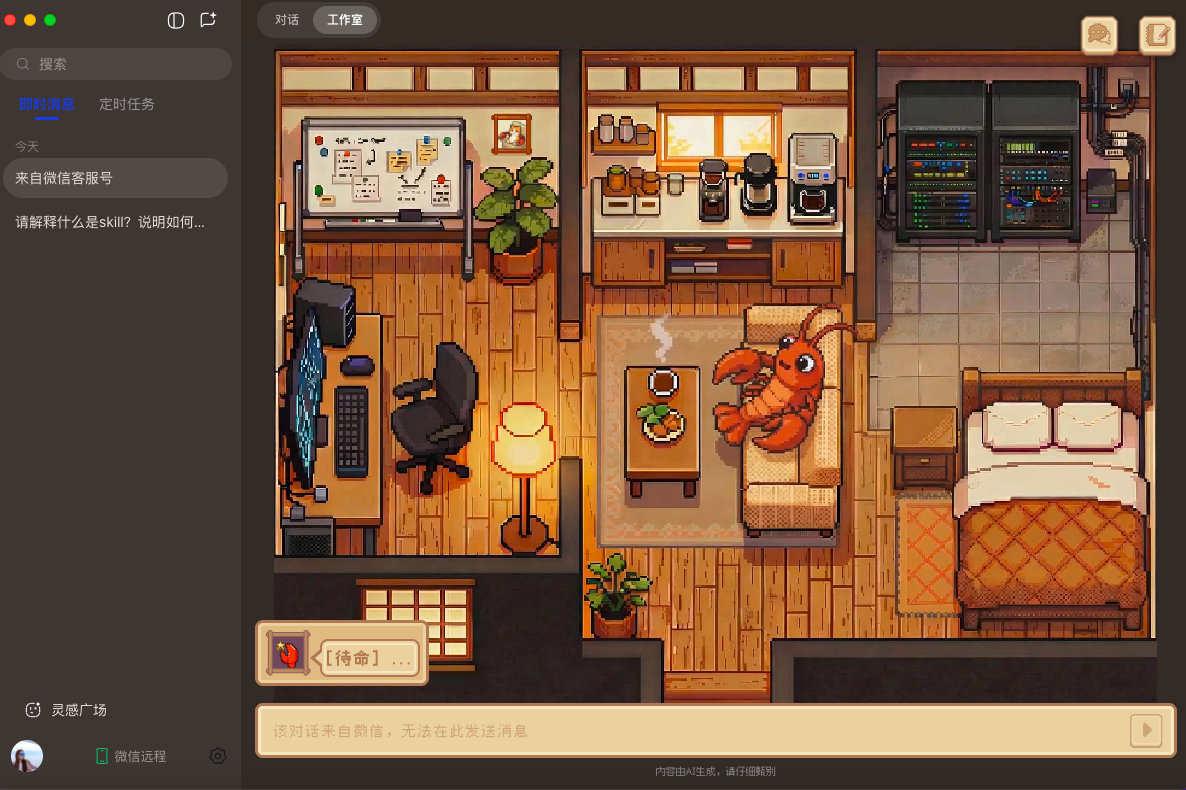
In this V0.1.9 update, QClaw introduced a UI design with real warmth—“Lobster Studio.” It’s a cozy, pixel-art cabin where users can literally watch the lobster typing at a keyboard and looking at a whiteboard.
On the key “Skill” expansion front, QClaw offers a lot of flexibility. Users can import skill libraries directly from the open-source community on GitHub, and can even “build a skill from scratch” through natural-language conversation. For example, if you ask it to “create a news monitoring skill,” it can quickly understand the request and generate a customized skill that includes configurations such as pulling from multiple information sources and producing Chinese-language output.
But to be fair, this “lobster” still shows some of the familiar large-model issues at this stage—hallucinations and limited ability to adapt on the fly.
When QClaw was told to “based on the above conversation, write a WeChat Official Account post announcing the new QClaw version update,” once its attempt to search for information was blocked, it simply ditched the earlier context and cobbled together an irrelevant piece of science-pop content from basic public information about QClaw just to get something out the door.
And Qclaw was told to “switch to a nicer-looking cyberpunk profile picture,” it didn’t carry out the change directly. Instead, it output a Midjourney prompt and left the user to generate the image themselves.
This suggests that, when it comes to complex task chains, the personal edition agent still needs a human “boss” to serve as the backstop.
But that imperfection doesn’t affect Tencent’s product cadence.
Looking across its agent lineup, the playbook of the big players is obvious at a glance: the QClaw mini-program version is merely a free “lobster” used to break into the education market and cultivate mass-user habits.
Tencent’s real “commercial value net” is cast on the B2B side—Lighthouse cloud servers for developers (making money from instance rental and token fees), and the WorkBuddy desktop workspace for enterprise office scenarios.
It is reported that WorkBuddy has been upgraded to support one-tap direct connection via WeChat, with 20+ built-in Skills packs and MCP protocol support, enabling parallel work across multiple windows as well as enterprise-grade automatic reconnection after network outages. By using the free consumer-side “Crayfish” product to educate the mass market, it will ultimately steer team collaboration needs with extremely high requirements for data security and stability toward paid B2B cloud services and an enterprise-grade workspace—this is the full blueprint for tech giants to capture more profits in the agent wave.
 LIKE 0