Chelsea_Sun ・ 11 hours ago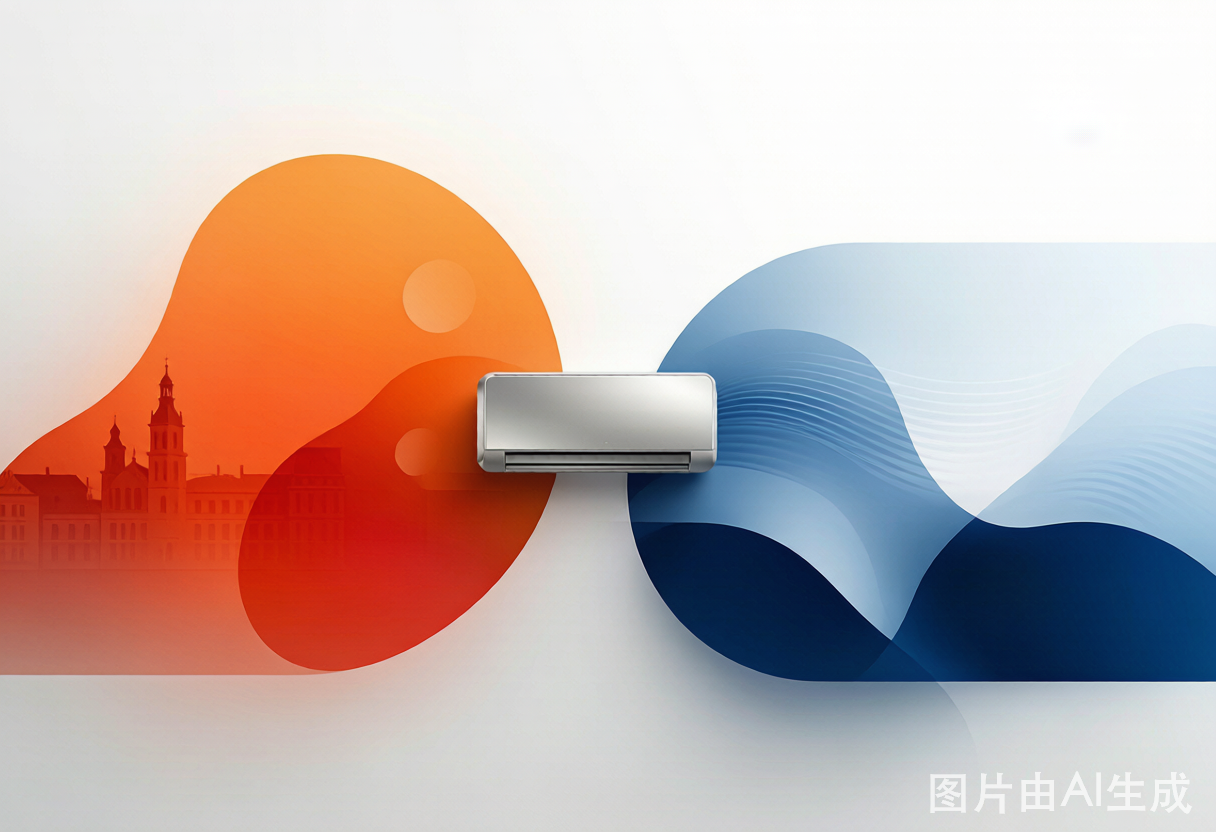
Europe has historically resisted the adoption of residential air conditioning—until this summer.
Last week, France recorded its hottest week on record. The national daily average temperature reached an unprecedented high, with some localized sensors peaking at 44.3°C. In response, 72 departments—covering roughly three-quarters of the country—were placed under the highest-level red alert for extreme heat. Meanwhile, in Andalusia, Spain, temperatures surged to 45.1°C, marking continental Europe’s highest temperature extreme of the century.
Amid this unprecedented heat wave, a Chinese-made portable air conditioner has become a runaway sensation across the continent. Midea Group’s "PortaSplit," a portable split-system air conditioner, has entirely sold out across Germany, Spain, and France. On secondary markets, desperate buyers are bidding up prices to two or three times the original retail mark.
It is far from an isolated phenomenon. Samsung has posted double-digit sales growth in Italy, Spain, and France; LG’s factories in South Korea have been operating at full capacity since April; and Mitsubishi Electric has seen a parallel surge in orders across the same markets. Asian climate-control manufacturers are collectively being inundated with European orders, and portable split systems have emerged as one of the summer's most talked-about consumer goods.
Severe Shortages and Brisk Secondary Markets
A standard PortaSplit model, which carries an official retail price of roughly €800 to €900, has been bid up to €2,679 on German second-hand e-commerce platforms. One Austrian consumer took to social media to lament that with Vienna forecast to hit 38°C, he spent two days searching across the country for the unit, only to find it entirely out of stock. Another German consumer noted that the units were unavailable within a 100-kilometer radius of his home.
The supply crunch has even spawned entrepreneurial pivots. In Cologne, German software developer Adrian Kübel launched braucheklima.de ("I need air conditioning"), a website offering real-time inventory tracking for Midea units across major home-improvement chains. Users can also pay a one-time fee of roughly €2.69 to receive three months of automated restock email alerts. The platform quickly went viral on regional social media.
Midea Group officially addressed the demand spike on June 29. Xiong Xueqin, director of Midea Air Conditioning’s European region, stated that PortaSplit’s business-to-business (B2B) shipments to Europe have exceeded 200,000 units so far this year, doubling last year’s volume. To satisfy urgent orders, the company has instituted overtime production at its factories and leveraged the China–Europe Railway Express for rapid overland transit. While some shipments have already arrived at destination ports, local subsidiaries are working to expedite customs clearance for swift delivery to retail partners.
In response to retail channels and secondary markets inflating prices by up to three to five times the original MSRP, Midea clarified that it currently has no plans to raise its wholesale prices.
Public markets have mirrored the consumer enthusiasm. When Hong Kong equity markets opened on June 29, Midea Group’s shares rallied more than 4% in early trading. According to customs data, China’s air-conditioner exports to the European Union totaled $3.76 billion in 2025—a record high representing a 43.2% year-on-year increase.
During the first five months of this year, Chinese air-conditioner exports to Western European nations, including France, the Netherlands, and Belgium, doubled year-on-year. Exports to Southern and Central European markets, such as Spain and Germany, also posted robust double-digit growth. Midea reported that its sales revenue in Western European countries with historically low air-conditioning penetration—including France, Spain, Germany, and the UK—rose by more than 70% year-on-year.
One Product, Three Structural Pain Points
The PortaSplit’s rapid ascent in Europe stems from its ability to solve three long-standing pain points in the continental market.
Historically, Europeans simply did not require residential air conditioning. Household AC penetration in the EU has long hovered between 20% and 30%, far below the roughly 90% levels seen in the United States (88%) and Japan (91%). In Germany, the adoption rate was lower still, estimated at just 3% to 6%. While figures vary slightly across institutions due to differing statistical methodologies, they have remained consistently low. This was not a matter of affordability; rather, European summers were historically mild enough that climate control was deemed a luxury rather than a necessity.
Climate change is rapidly upending that reality. The "heat dome" effect has repeatedly blanketed the continent, shifting extreme heat from a rare anomaly to the "new normal." Europe is currently warming at twice the global average rate. As temperatures exceeding 40°C become an annual fixture, life without climate control is growing increasingly untenable.
Yet, while air conditioning has suddenly become essential, installing a traditional split-system AC remains a bureaucratic and financial nightmare for most residents. Historic capitals like Paris feature strict preservation codes that forbid altering building façades, and many protected structures explicitly ban drilling into exterior walls. Furthermore, installations must be performed by certified professionals, commanding fees as high as €1,500 to €2,000 per unit, with summer waitlists stretching past two months. In several jurisdictions, a tenant or owner must also secure unanimous approval from the building's co-owners association. Consequently, installation often costs more than the hardware itself, and the bureaucratic hurdle can be more cumbersome than purchasing the property.
The obvious alternative—conventional portable air conditioners—presents its own drawbacks. Standard single-duct portable units are bulky, loud, and notoriously inefficient. Given the vast diversity of European window designs and the idiosyncratic architectural frameworks of older buildings, the user experience is frequently disappointing. Consumers often purchase them in a panic, use them for a few days, and then relegate them permanently to storage.
The portable split system circumvents all three barriers simultaneously. It requires no exterior drilling; the condensing unit can sit on a balcony floor, terrace, or deep windowsill, while the indoor unit can be positioned flexibly inside via an ultra-flat connection ribbon. Its cooling capacity closely rivals that of a permanent split system. In silent mode, it operates at 35 decibels, complying with Germany’s strict nighttime noise ordinances. By keeping its internal fluid volume safely below regional environmental triggers, it circumvents France’s stringent 2-kilogram regulatory threshold for specialized inspections, while its seasonal energy efficiency ratio (SEER) of 6.1 meets Switzerland’s stringent A++ standard.
Crucially, under French building regulations, the unit is classified as "internal equipment," allowing residents to completely bypass the regulatory hurdles associated with modifying exterior walls.
Some early adopters have calculated that after more than 200 hours of operations, their marginal electricity cost was under €30. While this represents an isolated, real-world scenario rather than a controlled laboratory metric, it underscores the unit's efficiency.
From Arbitrage to Localization
The PortaSplit’s success signals an evolution in Chinese manufacturing strategy: shifting away from low-cost export arbitrage toward engineering products tailored specifically to local regulatory frameworks and consumer habits.
The PortaSplit was not built by simply transplanting a domestic Chinese model into the European market. Instead, Chinese engineering teams spent years studying European architectural constraints, consumer behaviors, and real-world compliance environments. The product does not compete on price alone: the cooling-only variant retails for roughly €800 to €900, while the heat-pump heating-and-cooling version commands about €1,200. Its competitive edge lies in offering a lower total cost of ownership (including zero installation fees) than a permanent split system, alongside a significantly better user experience than traditional portable units.
This hyper-localization is evident in technical details that might seem minor but are legally vital to European consumers.
By meticulously minimizing the unit's chemical profile to stay below France's 2-kilogram regulatory classification threshold, Midea maximized cooling capacity while avoiding mandatory, complex environmental filings. The 35-decibel acoustic profile was engineered specifically to comply with localized nighttime noise limits across German states. Because French building codes categorize the unit as internal equipment rather than a structural modification, renters can install it themselves without seeking a landlord's formal consent. None of these design choices were accidental; they represent a meticulous mapping of product architecture to regional law.
To be sure, the portable split category is not an exclusive Midea invention. Japan’s Daikin and South Korea’s LG have both developed similar concepts; Samsung and Mitsubishi Electric have also scaled up European shipments to capitalize on the heat waves, and local European brands are moving quickly to catch up.
Midea’s current advantage relies more on its hyper-agile supply chain and strategic pricing bracket than on an insurmountable technological moat. As European demand surges, Midea’s manufacturing hub in Shunde is running overtime to increase output, while domestic rivals Gree and TCL have also boosted capacity. However, the window of opportunity for European, Japanese, and Korean competitors to respond is widening.
Whether this seasonal spike will translate into permanent brand equity for Chinese HVAC manufacturers in Europe remains an open question. Historically, Japanese automakers broke into the U.S. market during the 1970s oil crisis on the back of fuel efficiency—but what cemented their market share was a subsequent decade of sustained investment in build quality, customer service, and brand trust. Midea has successfully captured a tactical window; the long-term play lies ahead.
Beyond the Summer Surge
This wave of panic buying may prove to be a prologue.
A consensus among climatologists and industry analysts suggests that this period of extreme heat is no anomaly, but rather a structural shift toward a warmer European baseline driven by global climate change. According to research from the University of Oxford and the University of Bristol, eight of the ten countries projected to see the sharpest increases in "cooling degree days" are located in Northwestern Europe.
A vast majority of Europe’s building stock was constructed to architectural standards optimized for a cooler climate, and retrofitting these structures will take decades. As an official at the International Energy Agency noted: “As extreme heat and its impacts on public health continue to intensify, European attitudes toward air conditioning will undoubtedly undergo a fundamental shift.”
Yet the operational headwinds for manufacturers remain significant. Forecasts indicate that the air-conditioning industry will continue to face commodity price pressures through 2026, with elevated copper prices squeezing manufacturer margins. Tightening EU energy-efficiency mandates and evolving F-gas regulations are also forcing companies to accelerate their technological cycles.
Market leaders are already positioning themselves for a post-subsidy landscape. Midea has completed carbon-footprint accounting for five product categories and more than 60 core residential models, and has shipped over 10 million units utilizing the eco-friendly R290 refrigerant. However, early preparation does not guarantee complacency; regulatory updates in the EU routinely outpace corporate projections.
For a consumer product to achieve viral velocity in Europe requires far more than mere luck or a well-timed heat wave. It demands deep insight into localized market friction, a sophisticated command of regional regulations, an agile supply chain, and continuous capital deployment toward product innovation.
Ultimately, engineering a temporary sales surge and establishing a permanent institutional foothold are two distinct challenges. The true barrier to entry in the European market has never been sales velocity—it is regulatory standards. The EU’s stringent energy-labeling regime, the impending Carbon Border Adjustment Mechanism (CBAM), and the phased bans under F-gas regulations all point to a singular market reality: the long-term survivors in the European market will not be the lowest-cost producers, but the most compliant. The PortaSplit is currently capitalizing on a cyclical demand window, but converting that window into lasting brand equity will depend entirely on Midea’s sustained commitment to product iteration, localized service infrastructure, and regulatory agility.
This summer, the air conditioners Europeans are scrambling to buy are solving a tangible, immediate problem. Amid a perfect convergence of shifting climate realities, complex local ordinances, and manufacturing precision, Chinese industry managed to seize the moment.
(This article was first published on the TMTPost App. Author: TMTPost Objective Consumption; Editor: Zhao Hongyu)
 LIKE 0