Chelsea_Sun ・ 10 hours ago
The crowded, snake-like queue at WAIC led to a single attraction: an AI guitar capable of "improvisational jamming."
During the 2026 World Artificial Intelligence Conference (WAIC), the annual updated edition of the Tianpule AI Guitar made its public debut. Over the same period, Quwan Technology, the parent company behind the instrument, released the Tianpule Large Model V4.7, pushing music-focused foundation models toward a new frontier where they can "understand revision feedback."
It was unmistakable to anyone on the floor that this year’s WAIC generated unprecedented buzz. Yet the AI industry itself, having weathered countless hype cycles and technical trends, is bidding farewell to the hollow "compute arms race." The commercial value of large models is finally being realized within vertical, domain-specific scenarios.
Industry observers are increasingly turning their focus toward a path distinct from general-purpose large language models: vertical integration. Compared with tech giants basking in haloed reputations and star AI startups boasting eye-watering valuations, vertical AI developers have quietly stepped into the center stage of the AI era. Grounded in user scenarios and equipped with self-sustaining revenue capabilities, they have emerged as pragmatic, viable models for the industry.
By anchoring its strategy strictly on AI music and AI voice, and extending those capabilities into AI hardware, Quwan Technology offers a compelling case study of this trajectory.
Bidding Farewell to the Compute Arms Race: A New Narrative in Vertical AI Commercialization
The standard competitive posture in the large-model arena has long been a classic arms race: parameter count, context window length, and multimodal capabilities served as explicit metrics of a company’s worth.
By this year, however, this model of horizontal expansion has hit diminishing marginal returns. On one hand, general-purpose models suffer from worsening homogeneity, and products that rely solely on model API outputs struggle to build user stickiness. On the other hand, as AI penetrates deep into everyday life rather than acting merely as a productivity tool, technology must be embedded into concrete scenarios to solve real pain points.
Quwan Technology abandoned the illusion of building a jack-of-all-trades general platform, choosing instead to double down on two vertical domains characterized by high emotional value and dense interaction: AI music and AI voice.
Though operating in different tracks, their underlying logic is remarkably similar: humanity’s most natural, non-textual modes of expression have long been constrained by professional barriers, and both possess an inherent capacity to stretch from digital content into physical hardware.
The foundation of Quwan’s AI music ecosystem is the proprietary Tianpule Large Model. Steering clear of open-source fine-tuning, Quwan built the model from scratch to optimize for real-time interaction, laying the groundwork for a conversational creative experience powered by AI agents.
During WAIC 2026, Quwan rolled out Tianpule Large Model V4.7, making AI-generated music far easier to control and iterate upon. Across two evaluation frameworks, Meta Audiobox Aesthetics and SongEval, V4.7 earned high marks in metrics such as content enjoyment, memorability, and vocal clarity, while ranking in the top tier for musicality, coherence, and naturalness.
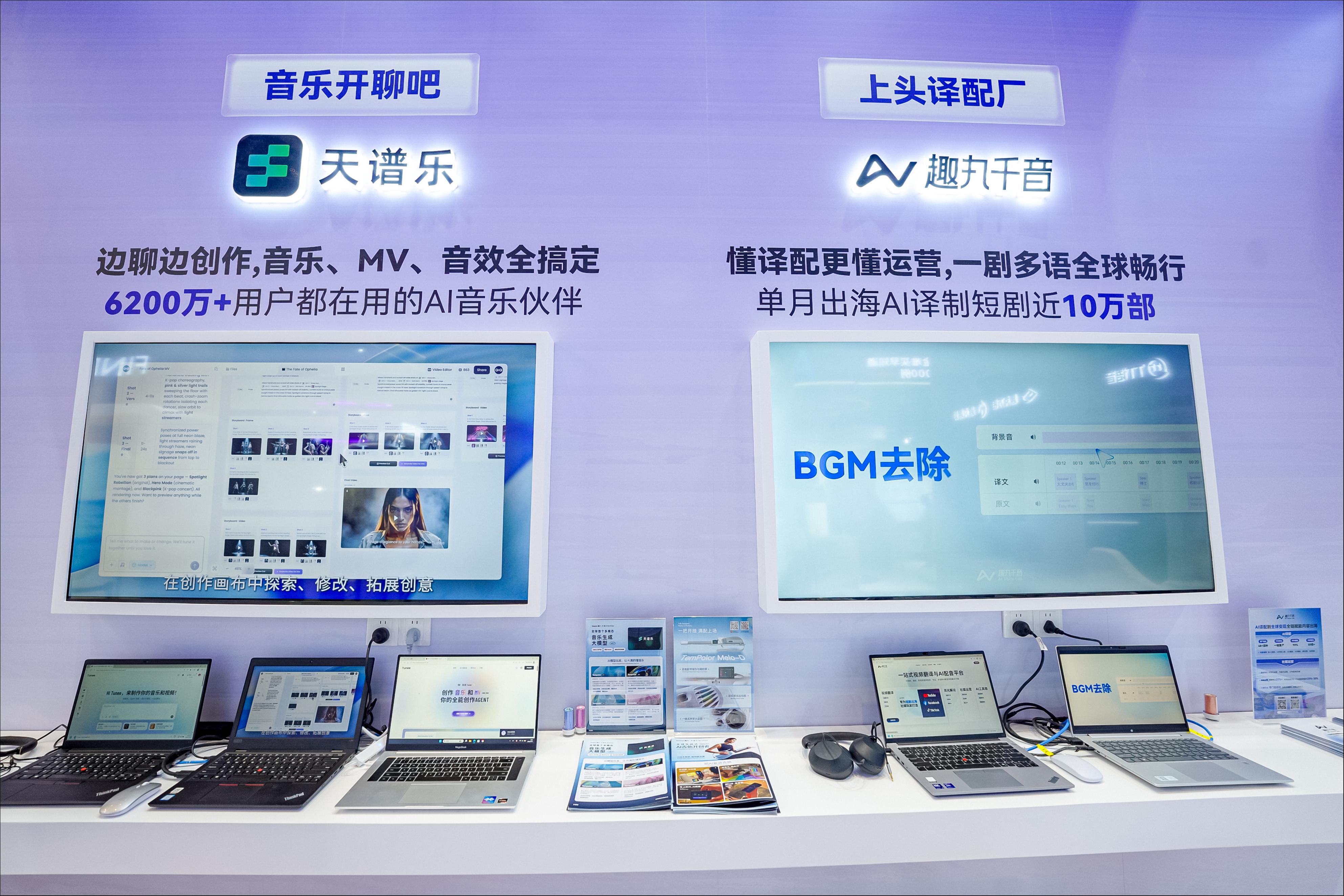
V4.7 powers Tunee, Quwan’s conversational music creation agent. This "conversation as creation" interaction model represents a true breakthrough in its capacity for proactive co-creation. Moving beyond passive "one-click generation" tools, Tunee acts more like a patient, music-savvy collaborator.
Since its official launch last September, Tunee’s official website has maintained over a million monthly visits, making it one of the fastest-growing breakout products in China’s AI agent space.
What has truly commanded the industry's attention, however, is the Tianpule AI Guitar. As a pioneer in the global generative AI guitar category, it was the first to embed an AI music foundation model into a physical guitar, enabling people without musical training or theory knowledge to experience the joy of playing and composing music.
At WAIC 2026, the new Tianpule AI Guitar placed heavy emphasis on its core feature introduced this year: "AI Improvisation." Users can generate personalized music directly on the instrument and jam along, drastically simplifying the complex journey from composition to performance. Coupled with features like AI score transcription and hum-to-song conversion, complete beginners can quickly begin playing and writing music.
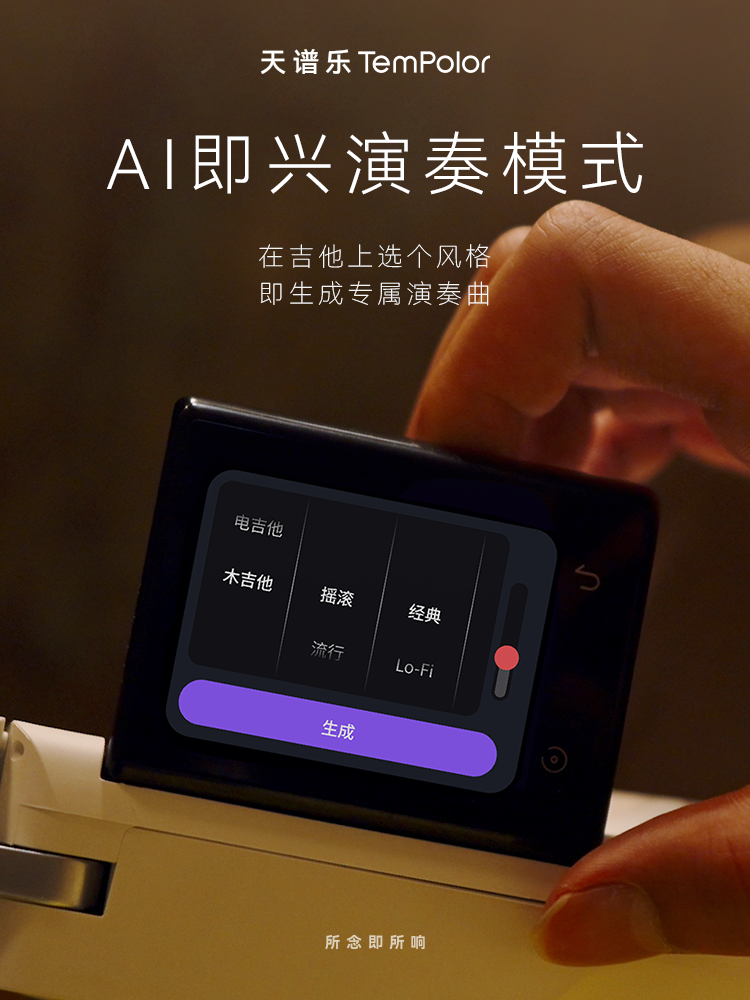
The industrial significance of the Tianpule AI Guitar extends far beyond consumer electronics. It frees generative AI from behind the glass screen, turning it into a physical object that can be touched, plucked, and felt through resonance. For professional musicians, it serves as a catalyst for inspiration; for novices, it is the first key to unlocking the world of music.
As Jasper Jia, Vice President of Quwan Technology, put it: only when ordinary people can use music to express emotions and document their lives as naturally as taking a photo or shooting a video will music truly become an inclusive medium for creation. The physical medium of the guitar allows AI music to step outside smartphones and laptops, truly weaving itself into everyday life.
Quwan Technology’s vertical integration has constructed more than just a tech flywheel—where the model grants intelligence to the application, and the application breathes fresh experiences into the hardware. Simultaneously, the hardware feeds real-world user interaction data back into the model, establishing a system-level moat.
In truth, AI has already made creation ubiquitous. But how to make good content visible, scalable, and profitable has become the stark reality facing the second half of the AIGC race.
Quwan Technology’s answer to that reality is AI voice.
In recent years, the overseas expansion of Chinese film and television productions has accelerated rapidly. Dubbing and localization, however, have remained a persistent industry pain point. High quality, high efficiency, and low cost form a classic impossible trinity.
Against this backdrop, Quwan Technology collaborated with The Chinese University of Hong Kong, Shenzhen, to develop the MaskGCT voice foundation model. On October 24, 2024, MaskGCT was officially open-sourced to the world via the Amphion framework. Across multiple text-to-speech (TTS) benchmark datasets, MaskGCT achieved state-of-the-art (SOTA) performance, even outperforming human baselines on select metrics.
All Voice Lab (Quwan Qianyin) represents the commercial application built atop the MaskGCT model.
As a one-stop video translation and AI dubbing platform, All Voice Lab slashes AI translation and dubbing costs by 90% compared with traditional human labor while boosting speed more than 50-fold, handling a monthly translation volume of up to 500,000 minutes (roughly 5,000 drama episodes).
Since its launch, All Voice Lab has assisted over 100 film, TV, and animation clients in solving localization hurdles. It processes nearly 10,000 short drama episodes per month across single languages for overseas markets, reaching over 30 countries and regions globally and helping clients boost monthly YouTube channel revenue by 10% to 30%.
Driven twin-engine style by AI music and AI voice, Quwan Technology is transitioning into a "new infrastructure" provider for the entertainment industry. It proves that vertical AI companies do not need to serve everyone; by achieving excellence within targeted vertical domains, they can unearth vast commercial value.
From Mobile Voice to AI Creation: Quwan’s 12-Year Evolution of "Interest"
The first half of Quwan Technology's journey followed a textbook mobile internet success story. Its flagship product, TT Voice, evolved from a simple voice tool designed to help gamers find teammates into an interest-based social platform boasting over 200 million registered users. When the AI wave swept the globe, the company pivoted proactively, laying early groundwork in AI as far back as 2021 to secure its current position as a leader in AI entertainment.
The essence of the company’s 12-year evolution represents a strategic leap from "connecting interests" to "creating interests." Yet the underlying logic running through it all has always been a focus on "interest" and a "human-centric" philosophy.
For instance, TT Voice’s early positioning was remarkably simple—a "gaming walkie-talkie." But what fundamentally transformed founder Song Ke's understanding of the product’s value was the spontaneous behavior of its users.

He noticed that many users did not leave the voice rooms after finishing their games; instead, they stayed to sing, chat, and share their lives. He realized then that while the platform ostensibly solved an efficiency problem ("how to play games better"), it was actually fulfilling an emotional need ("how to connect better with people").
Grounded in this insight, TT Voice quickly evolved from a tool into a community. Beyond gaming matchmaking rooms, it rolled out diverse interest spaces including singing rooms, chat rooms, and audio-visual rooms.
In cultivating the social space, Quwan Technology identified an emerging industry trend: the new generation of users was no longer satisfied with merely consuming content; they craved autonomous creation and self-expression.
This was no mere hypothesis. On the TT Voice platform, users were already looking beyond finding gaming buddies—they were singing in voice rooms, sharing life moments in chat rooms, and expressing themselves in communities. As AI technology matured, these deeper desires could finally become reality.
In the past, completing a song—from lyrics and composition to arrangement, mixing, and recording—demanded specialized skills at every step. Many possessed creative sparks or deep emotions but struggled to translate the melodies in their heads into finished works.
In 2024, the team set out from scratch to build "Tianpule," a multimodal music generation model, choosing a self-developed path distinct from open-source fine-tuning. In the AI voice domain, Quwan partnered with CUHK-Shenzhen to open-source the MaskGCT voice model.
Quwan develops both AI music and AI voice; it launches AI hardware while maintaining an interest-based social platform with over 200 million registered users. While its business scope appears broad, it is built upon a single, continuously expanding set of core AI interaction capabilities.
Across its distinct business lines, Quwan serves diverse sectors—music creation, content globalization, public services, and social networking. From an architectural standpoint, however, they all draw from the same underlying AI interaction capability.
Looking back at Quwan Technology's 12-year trajectory, a clear thread emerges: the first half was about "connecting interests"—using interest communities to bring together young people seeking belonging; the second half is about "creating interests"—using AI to lower creative barriers so anyone can convert ideas into digital assets and passion into sustainable expression.
Sustaining this arc is not the pursuit of tech trends, but an unwavering understanding of "interest" and "people." Whether with TT Voice or AI music, Quwan’s ethos places user insight ahead of technical R&D. This product philosophy—starting with the human element and designing backward from the ultimate user goal—ensures that technical iterations always revolve around real-world scenarios rather than descending into pure technical rivalry.
Moving from "connecting interests" to "creating interests" is not only Quwan Technology’s internal evolution, but also an answer to how technology can truly serve human beings. No matter how technology changes, the essence of business remains constant: to understand people, serve people, and empower people.
Conclusion
Twelve years ago, Quwan Technology answered one question: How do you help people who love playing games find one another? Twelve years later, it is answering another: How can every ordinary person be given the chance to create their own work and express their unique passions?
While the industry remains locked in fierce rivalry over conventional paths—whether single-point tools or general-purpose platforms—Quwan Technology has used vertical integration as an anchor to build a closed-loop "Model-Application-Hardware" ecosystem across AI music and AI voice.
This is a direct response to the true nature of AI commercialization: technology can only weave itself into the fabric of everyday life and form a sustainable business model when it penetrates all the way through foundational algorithms, intermediary interactions, and physical hardware devices.
(This article was first published on the TMTPost App; author | Li Chengcheng)
 LIKE 0